
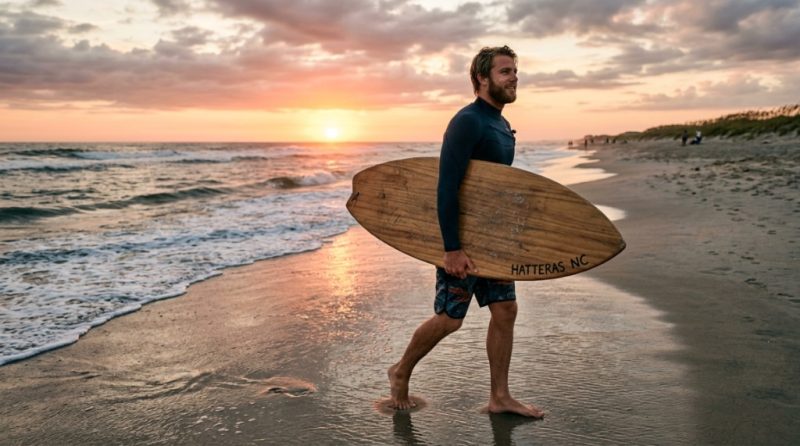
You’ve just driven down to Atlantic Beach or hit the shores near Wrightsville, and you’re ready to drop your board on the sand. But between the parking lot and the waterline, there’s a minefield of obstacles: rental bikes, discarded fishing line, curious toddlers, and the ever-present North Carolina wind. Carrying a skimboard seems simple, but doing it wrong can damage the board, hurt your back, or send the deck flying into traffic. More importantly, a loose board on a crowded beach is a safety hazard. This guide covers exactly how to carry skimboard safely NC beaches demand, from proper grip techniques to choosing the right transport gear for our specific coastal conditions.
Key Takeaways
- Always carry your skimboard with the fin side facing away from your body to prevent cuts and snags.
- The beach break and wind patterns in NC require specific carrying techniques to avoid the board acting like a sail.
- Never walk near dunes or boardwalks with an uncovered board; the risk of sand flipping into your eyes is high.
- Investing in a padded bag or shoulder strap is the most effective way to protect your board and bystanders during long walks.
- Heat and humidity in North Carolina cause boards to warp; how you carry and store the board matters as much as the carrying motion itself.
Why Carrying Your Skimboard Wrong Is Dangerous
Skimboards are flat, slippery, and often have sharp edges, especially if you ride a carbon fiber or fiberglass model. In North Carolina, where beaches are frequently crowded during summer months, holding the board incorrectly can lead to accidents. The primary risks include striking someone with the edge of the board during a gust of wind, dropping it on your foot, or having the board slip out of your sweaty hands and slide across the sand into the surf where you have to chase it.
The most common mistake is carrying the board under the arm like a textbook. This position leaves the sharp tail pointing backward. If you trip or get bumped, the tail can jab into the person behind you. It also puts strain on your lower back because the board forces your shoulder into an uneven posture for long distances. To carry skimboard safely NC locals and visitors alike need to treat the board less like a toy and more like a sharp, expensive piece of sporting equipment.
Another overlooked danger is the board’s interaction with wind. NC beaches are notoriously breezy, especially in the afternoons. A flat board held horizontally will catch the wind like a wing, jerking your arm violently. That sudden jerk can pull you off balance or twist your wrist. You need a carry position that minimizes surface area facing into the wind.
The Proper Grip Techniques for Different Scenarios
The Side Carry (Standard Walking)
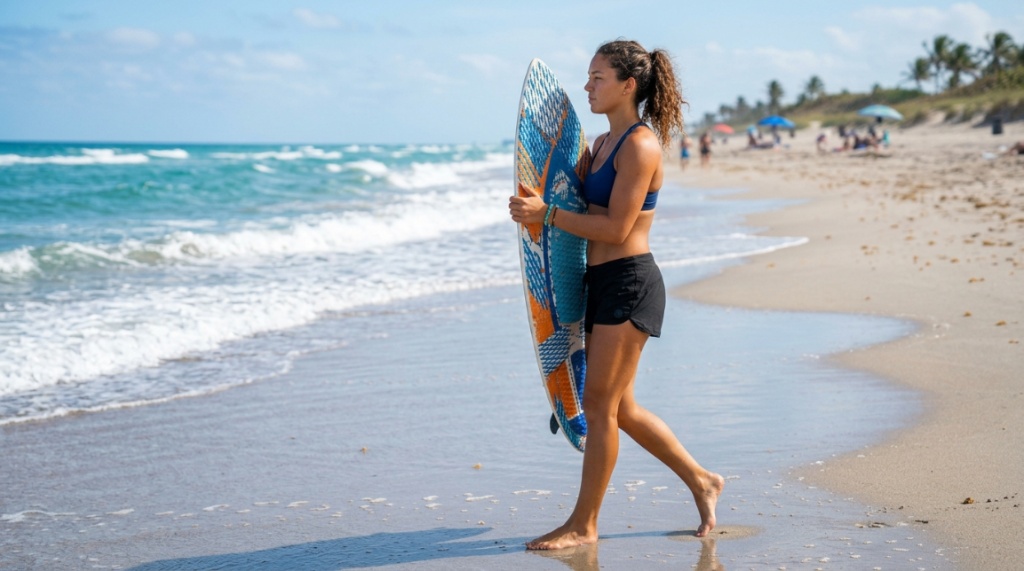
This is the safest method for moving from your car to the water on a flat, unobstructed path. Place one hand on the back of the board (the tail) and the other hand on the front (the nose). Hold the board vertically against your hip, with the top edge leaning against your body. Crucially, the bottom of the board (where the fins are) should be facing forward, away from your legs. This prevents the fins from catching on your shorts or scratching your skin while you walk.
When walking with this carry, keep your elbows slightly bent. You are not squeezing the board against you with a death grip; you are simply guiding it. Let the board rest on your hip bone, which takes the weight off your arms. This is often how you carry skimboard safely NC surfers do when traversing the long stretches of sand between the access points and the water’s edge. If you need to navigate through a crowd, turn the board so it is edge-first (pointing forward like a sword) to minimize your width profile. Keep the nose pointed slightly down so you don’t accidentally poke someone in the face with the tip.
The Two-Handed Front Carry (High Wind Conditions)
When the wind is strong, usually during the late afternoon sea breeze, the vertical side carry is risky because the board acts as a massive sail. In this scenario, switch to a two-handed front carry. Hold the board horizontally in front of you with both hands on the rails (the edges). Tilt the board slightly upward, angling the nose up and the tail down. This angle breaks the wind, allowing air to spill over the top of the board rather than pushing against it.
Keep the board close to your chest. This spreads the weight and makes the board easier to control against gusts. While this looks a bit awkward, it provides the most control when winds exceed 15 mph, which is common on the Outer Banks. Always keep the fins pointed down toward the sand. If you hold the fins up, you risk striking yourself in the chin if the board slips.
The Overhead Carry (Rocky Access Points)
At some NC beaches, like the access points near Cape Lookout or otherwise rocky jetties, the ground is not even. Dragging the board or holding it low risks striking rocks. Carefully lift the board overhead, flat against your palms, with your arms fully extended. This keeps it away from obstacles. However, you must look up to ensure you don’t hit low-hanging branches or overhead signs. This carry is less comfortable but necessary when stepping over large driftwood or navigating rocky jetties without scuffing the bottom.
Choosing the Right Carrying Gear
Your hands can only do so much. For longer walks, or when you have your hands full with a beach chair and a cooler, you need additional help. This is where carrying equipment becomes essential, and the choice depends on how far you are walking and the type of skimboard you own.
Skin & Foam Boards (Lightweight)
For beginner foam or wooden boards, which are surprisingly heavy, a simple soft-top bag with a shoulder strap works best. They protect the board from UV rays (which can degrade the foam) and make the weight more manageable on your shoulder. Look for a bag with a webbed handle on both the top and the side. This allows you to switch between a hand carry and a shoulder carry without putting the board down on the dirty parking lot pavement.
Carbon Fiber and Fiberglass Boards (Expensive & Fragile)
These boards are much lighter but exponentially more expensive and prone to chipping. You should not be walking around with these bare. You need a padded bag that protects the rails from impacts. If you are walking more than 200 yards from the car to the beach, a bag with padded backpack straps is the best option. It distributes the weight evenly across your back and keeps your hands free to hold coffee or fishing rods. To effectively carry skimboard safely NC conditions often require a bag that resists sand ingress, as zippers clogged with abrasive sand will fail quickly. A bag allows you to support the board against your back, keeping the fin side away from your spine.
Pre-Transport Inspection Checklist
Before you even pick up your board, you need to check several things. Safety on the beach doesn’t start when you start walking; it starts at the car. First, inspect the fins. Ensure that all safety screws are tight. A loose fin can catch on clothing or cut your hand when you go to grip the board. Next, check the traction pad. If it is peeling, it can snag your fingertips and cause you to lose grip, resulting in the board flying out of your hands.
Finally, dry the board. This is a major issue in NC’s humid summer. If the board is wet, it becomes incredibly slippery. Walk to your car, wipe the board down with a microfiber towel before you start walking across the pavement. This gives you a secure grip from the start. Do not walk with a wet board over your shoulder without wearing a shirt; the suction effect of the board on your bare skin will cause friction burn as you walk.
Environmental Considerations in NC
North Carolina brings specific conditions that affect how you should carry your skimboard. The sand here can be “sugar sand,” which is very fine and deep. Carrying a board low to the ground while dragging your feet can cause the board to dig into the sand if you stumble. Always lift the board slightly higher when walking through the soft sand at places like Emerald Isle or Ocean Isle Beach.
Also, pay attention to the tide levels. During high tide at places like Wrightsville Beach, the high tide line pushes you closer to the dunes. The dune vegetation (sea oats and American beach grass) is federally protected in NC. If you are carrying a board sideways to avoid the water, you might accidentally knock the fragile dune grass. Always choose the water-side path, carrying the board higher to avoid dipping it into the surf spray, which will make it wet and slippery for the walk back, To ensure you have the right gear before heading out to the waves, make sure to Select a Skimboard Based on Your Skill Level.
Navigating Crowds and Boardwalks
The busiest times on NC beaches are between Memorial Day and Labor Day. Navigating through a dense crowd with a skimboard is high-risk. The board is long, and people sitting on blankets don’t expect a board to swing at head height. When walking through the throng, switch to the “sword position.” Hold the board vertically, nose pointing straight up, tail pointing down. Use one hand to hold the rail and the other to steady it against your shoulder.
As you walk, look ahead for potential collisions. Weave through the crowd. Do not walk behind people who are casting fishing lines—the hooks can snag your board’s traction pad or your arm. If you are walking on the boardwalk in towns like Carolina Beach, be aware of the gaps between wooden planks. If you drop the board, it could wedge into a gap and snap the nose. Carry the board horizontally over your arms when on boardwalks to avoid this risk.
Common Mistakes to Avoid
There are a few common errors that almost always lead to damage or injury. Let’s break them down.
- Dragging the tail: We’ve all seen people dragging their skimboard behind them like a surfboard. This grinds the tail down and creates sharp, ragged edges that cut your feet. Never let the board touch the pavement or rocks.
- Choking the rails: Grabbing the board tightly by the rails (squeezing the edges) flexes the deck. Over time, this causes the board to lose its pop and stiffness. Carry it by the body, resting it against you, rather than squeezing the edges.
- Walking into the wind: If you are walking north into a south-facing wind, the wind will hit the bottom of the board. This will push the board backward. If you cannot avoid the wind, angle the nose down slightly to deflect the air.
- Holding it like a serving tray: Holding the board flat with two hands in front of your stomach is dangerous. It blocks your view of the ground, causing you to trip over boogie boards and sandcastles. Always keep the board to your side.
Frequently Asked Questions
Should I carry my skimboard with the fins facing me or away from me?
Always carry the skimboard with the fin side facing away from your body. If the board slips, the fins will not cut your legs or torso, and they will not catch on your clothing, which could cause you to trip.
Is it better to carry a skimboard under my arm or with a bag?
For short distances (under 100 yards), carrying it under your arm is fine. For longer distances or if you have other gear, use a padded shoulder bag. A bag protects the board from UV rays, sharp edges, and impacts while distributing the weight more evenly.
Can I carry a skimboard on a backpack?
Yes, but only if the backpack is designed for skimboards or surfboards. Standard hiking backpacks do not have the necessary straps to stabilize a wide, flat board. A skimboard-specific backpack allows you to strap the board vertically across your back, leaving your hands free.
How do I protect my skimboard from the NC heat when walking to the beach?
The black asphalt of parking lots heats up quickly. Never leave your board sitting on the pavement even for a minute. While carrying it, keep it shaded by your body if possible, and avoid letting it bake in the direct sun for long walks, as heat can cause delamination in foam boards.
What is the best way to carry a wooden skimboard without hurting my back?
Wooden skimboards are heavy. Use a two-handed carry directly in front of your chest with the board vertical, or hold it on your hip with one hand at a time. Switch hands every few minutes to reduce muscle fatigue and avoid straining your lower back.
Conclusion
Carrying your skimboard safely in North Carolina comes down to being mindful of your surroundings and deliberate with your movement. Whether you are walking down a deserted stretch of beach at sunrise or navigating a packed summer crowd at Pine Knoll Shores, the rules remain the same: keep the fins away from your body, minimize the board’s profile in the wind, and use the proper gear for your equipment type. By following these guidelines, you protect your board from damage, avoid injuries to yourself and others, and ensure that your energy is spent on catching waves rather than wrestling with your equipment. Next time you hit the beach, take that extra second to adjust your grip—your back, and the people around you, will thank you.
